
30+ Branding Statistics That Reveal the Trends Shaping 2026


Branding in 2026 is shaped by clear data. If you want to understand how to raise conversion, strengthen emotional connection, and turn casual buyers into returning customers, the insights in this article will help you do that.
Here you’ll find branding statistics supported by real market patterns, plus short conclusions that show how specific branding decisions reduce confusion across channels, improve trust signals, and create a clearer product story. Our Arounda Team prepared this article to give you practical numbers you can use to adjust your strategy.
Article Key Takeaways
Many companies face dropping conversion rates, inconsistent messaging across channels, outdated visuals that reduce trust, and a weak emotional connection with customers. This article explains how branding travels through every touchpoint and what the latest data shows about these problems.
This article provides:
- 30+ branding trends
- Market insights
- Practical explanations
- Data-backed signs that a brand needs a refresh
- Professional advice on fixing branding issues.
.avif)
Branding Statistics That Actually Move Business Metrics
This section curates the most relevant statistics that indicate how companies perform in 2026. The statistics highlight the role of an emotional branding strategy, the way brands support trust, preference, and confidence during customer decision-making. Beyond the numbers, this section explains what these patterns reveal about where the market is heading and which branding choices are becoming critical for sustainable growth.
Brand ROI & Business Impact
- 3× more likely to exceed revenue goals with branded personalization: Companies that lead in personalization are three times more likely to exceed their revenue targets compared to industry peers. Deloitte’s 2025 Marketing Trends report links this performance to investments in data, design, and brand-led personalization across customer touchpoints.
Marketing Trends of 2025, Deloitte - 52% of consumers stopped buying after a bad brand experience: PwC’s 2025 Customer Experience Survey found that 52% of consumers stopped buying from a brand after a single bad product or service experience. The survey measured customer behavior following negative interactions with brands.
2025 Customer Experience Survey, PwC - Up to 3.5× higher revenue growth when BX and CX are aligned: Forrester’s 2025 Total Experience research shows that companies aligning Brand Experience (BX) with Customer Experience (CX) achieve up to 3.5× higher revenue growth potential. The comparison is based on performance differences across organizations measured in the study.
Forrester - 80% of consumers are more likely to purchase from personalized brands: Deloitte’s 2025 research reports that 80% of consumers are more likely to buy from brands that deliver personalized content and experiences tailored to their context. The finding is based on consumer responses across digital and physical channels.
Marketing Trends of 2025, Deloitte - 61% of B2B marketers prioritize building trust and credibility over other content outcomes: According to Statista’s Content Marketing Trend Study 2025, 61% of B2B marketers named building trust and credibility as the most important benefit of their content efforts. In the same study, trust ranked higher than engagement and lead generation.
Content Marketing Trend Study, Statista
Our prediction for 2026:
We’ll judge branding by how much we can see it relieving hesitation at those decisive points of purchase. The branding stats above speak to the same theme: customers bolt after a single bad experience, react to relevant communication, and stick around with brands that make them feel predictable and trusted. These signals align with current brand design trends, where growth and retention depend on how well positioning turns into clear pricing logic, understandable product value, and a consistent experience before and after purchase.
Arounda’s tips to improve brand ROI:
- Define which decision branding should simplify. Decide whether branding needs to help customers compare faster, understand pricing, or trust the product enough to stay. Teams that focused branding work on pricing pages or onboarding often improved conversion without increasing traffic.
- Check promises against real usage. Compare what marketing claims with what users see in the product, demos, and post-purchase flows. Fixing these gaps usually reduces early churn within the first months.
- Read trust through behavior. Watch early drop-offs, repeated clarification questions, sales cycle length, and post-purchase churn. These signals show whether branding reduces uncertainty or creates it, directly affecting revenue stability.
Brand Consistency Matters
- 61% of consumers choose brands they trust: Edelman’s 2025 Trust Barometer shows that trust directly affects purchase decisions for 61% of consumers. When messaging or experience feels inconsistent, people hesitate at the final decision stage or simply choose a safer alternative.
Edelman Trust Barometer, 2025 - 74% prefer brands that feel relevant to them: According to Edelman’s 2025 research, 74% of consumers are more likely to choose brands that clearly reflect their needs and point of view. Brands that communicate the same idea across product, content, and experience are easier to recognize and faster to trust.
Edelman Trust Barometer, 2025 - −28% average bounce rate after brand-consistent UX updates: Across SaaS, FinTech, AI, healthcare, and Web3 projects, brand-consistent navigation, messaging, and visual hierarchy led to an average 28% reduction in bounce rate. Pages aligned to a single brand logic showed fewer early exits and faster progression into key flows.
Arounda Agency - 60% of leaders who use data to make decisions make more money than their competitors: Companies that use data to make decisions every day are more likely to make more money than their competitors. When data is stored in silos or different teams use different numbers, things take longer to get done, and the brand experience starts to break down across channels.
IBM / Salesforce Research, 2024 - Up to 3.5× revenue growth when brand promise matches experience: Companies that align their brand promise with the experiences they deliver achieve up to 3.5x revenue growth.
Global Total Experience Score Rankings, Forrester - 40% of consumers spend more time verifying brand information than five years ago: Gartner’s 2025 research finds that fragmented product, pricing, and service information forces customers to double-check credibility before buying. Inconsistent messaging increases decision time and reduces confidence during evaluation.
2025 Genius Brands Report, Gartner - Brand loyalty expected to decline by 25% in 2025: Forrester predicted a sharp drop in loyalty driven by price sensitivity and value comparison. In this environment, inconsistent brand promise delivery accelerated churn, as customers were less willing to tolerate friction or uncertainty.
B2C Marketing & Customer Experience Predictions 2025, Forrester
Our prediction for 2026:
Branding consistency will directly influence decisions at the comparison and pricing stages. Brand consistency statistics show that customers increasingly verify claims across marketing, pricing, product UI, and post-purchase flows before committing. Brands that present different value logic across these touchpoints will lose demand even with strong traffic, while growth will favor teams that align promises, pricing, and real experience.
Arounda’s tips to improve brand consistency:
- Force one decision definition across teams. Make marketing, product, sales, and support write the same answer to one question: “Why should a customer choose us over the competition?” Different answers mean consistency is already broken, regardless of visuals.
- Audit consistency where money changes hands. Skip brand decks. Review pricing tables, plan limits, upgrade paths, cancellations, and renewal emails. Inconsistency here increases hesitation, support load, and churn.
- Create a single source of brand truth beyond design. Demand a shared language system for value statements, feature explanations, constraints, and promises used by product UI, sales scripts, onboarding, and support. Without this, every team silently rewrites the brand in production.
If you see that your brand feels fragmented across channels and slows down decisions, it’s usually a signal that consistency needs to be rebuilt at a system level. Our rebranding services help teams fix this, delivering up to +30% brand awareness, 2× stronger impact of rebranding on product sales, and +30% growth in trust and security perception across key touchpoints.
Brand Recognition & Awareness
- “Elite” brands with high recognition and favorability are chosen more often: According to Forrester’s Brand Experience Index, brands classified as “Elite” are more likely to be purchased, recommended, and preferred, and are better positioned to command a price premium.
BX Index, Forrester - +39.7% average Brand Recognition lift after a brand identity rollout: Companies that build or refine their brand identity and apply it consistently across key touchpoints see an average +39.7% increase in brand recognition.
Arounda Agency - 60% higher repurchase rates for brands with strong awareness: Products with high brand awareness enjoy better customer retention, with repurchase rates 60% higher than those of lesser-known brands.
ResearchGate - Dynamic logos increase brand recall and recognition: Logos that use motion capture keep people's attention longer than static logos, which helps them remember and recognize the brand better.
Neuroscientific Analysis of Logo Design, MDPI - Color is the strongest driver of visual attention in logo recognition: Color was the most influential factor that attracted visual attention in both old and new logos, with statistical significance (p<0.05).
Impact of Color, Shape, and Typeface on Visual Attention, ResearchGate
Our prediction for 2026:
At the time of comparison, brand awareness will be measured more by recall than by reach. Brand awareness statistics already point to faster filtering behavior, where only brands with clear, repeatable cues stay memorable under pressure. Recognition will increasingly depend on simplified visual signals, reinforced by logos statistics showing how strong logo cues support instant identification. Teams that reduce recognition to a few consistent signals will hold attention in crowded markets.
Arounda’s tips to improve brand recognition:
- Anchor recognition to one visual cue. During logo creation, define one dominant element, such as color, shape, or motion, and require it to appear consistently in product UI, pricing pages, onboarding, and sales materials.
- Place recognition where decisions happen. Ensure your logo and key brand cues are visible at comparison points: pricing tables, plan selectors, security pages, and checkout. Recognition built on homepages rarely influences the final choice.
- Reduce variation before increasing reach. Before scaling campaigns, audit how many logo versions, color shades, and layouts exist across channels. Fewer variations improve recall faster than higher exposure.
Emotional Connection & Loyalty
- Emotional attachment strongly drives loyalty: When people feel emotionally connected to a brand, they’re much more likely to stick with it over time. Satisfaction deepens that emotional connection, moving feeling into long-standing loyalty.
Marketing Science & Inspirations, Academic Research - 70% of Gen Z stay loyal to brands they trust: SAP Emarsys reports that 70% of Gen Z consumers remain loyal to brands they genuinely like and trust. Emotional trust plays a bigger role in repeat choice than price or promotions for this audience.
Customer Loyalty Statistics report, SAP Emarsys - Customers with positive experiences are 4.1× more likely to recommend a brand: Qualtrics’ Global Consumer Experience Trends research shows that customers who report positive brand experiences are 4.1 times more likely to recommend the brand to others.
Global Consumer Experience Trends, Qualtrics - Satisfied customers are 2.3× more likely to increase their spending: Customers who are happy with their experience are 2.3 times more likely to spend more money with that brand over time.
Global Consumer Experience Trends, Qualtrics - Reliable brands retain loyal customers even after mistakes: When people see a brand as reliable, they are more willing to stay loyal and forgive mistakes if the issue is fixed quickly and clearly. Trust in how a brand acts matters more than being perfect.
Building Trust Through Reliability, Preprints - Loyalty defined by feelings drives 65% more repeat purchases than by rewards: Emotional connection drives 65% more repeat purchases than points or discounts. People come back because they feel they are attached.
Loyalty research, Brandmovers
Our prediction for 2026:
Customers will expect brands to stay involved after the purchase. The question many teams will face is simple: how does branding help to maintain customer loyalty when price, features, and competitors constantly change? Loyalty will grow when pricing rules, product limits, support answers, and follow-up communication follow the same logic and do not contradict each other. Brands that respond personally, explain decisions clearly, and stay consistent across these moments will keep customers longer and turn repeat purchases into a habit.
Arounda’s tips to improve connection and loyalty:
- Tie branding to post-purchase behavior. Use brand statistics to track where customers hesitate after paying: upgrade screens, limits, refunds, renewals. If branding stops at marketing pages and breaks in these moments, emotional connection collapses first.
- Design emotional consistency into problem resolution. Define how the brand speaks, reacts, and compensates when something goes wrong. The same brand logic should appear in support replies, timelines, tone, and outcomes.
- Personalize decisions. Emotional connection strengthens when branding adapts to user context, not colors. Show different explanations, defaults, and recommendations based on behavior and history.
When Brands Need a Refresh
- 34% of consumers are willing to switch brands for more personal relevance: Accenture’s Consumer Pulse Research 2025 shows that 34% of consumers would leave a preferred brand if a competitor makes them feel more personally understood or “special.”
Consumer Pulse Research 2025, Accenture - 52% of customers stop buying after a product or service fails expectations: PwC’s 2025 Customer Experience Survey reports that 52% of consumers stopped purchasing from a brand because the actual product or service experience did not match the brand promise.
2025 Customer Experience Survey, PWC - 48.6% of consumers question brand authenticity online: Accenture reports that 48.6% of consumers often or always doubt the authenticity of brand content and online reviews, reflecting growing skepticism toward generic and AI-driven brand communication.
Life Trends 2025, Accenture - 59% of CMOs say current strategy budgets are insufficient: Gartner’s 2025 CMO Spend Survey shows that 59% of marketing leaders believe they lack the budget needed to execute their current strategy, even as marketing spend stabilizes at 7.7% of revenue.
2025 CMO Spend Survey, Gartner - Up to 90% drop in social media follower growth for stagnant brands: Many traditional luxury and premium brands saw follower growth drop by up to 90% after failing to evolve their creative art direction and brand storytelling.
Bain & Company
Our prediction for 2026:
Brand refresh decisions will be triggered less by falling awareness and more by hidden revenue leaks visible in brand demographics and behavior data. Branding facts already show a pattern where customers do not complain or churn immediately, but stop upgrading, stop recommending, and quietly switch when a competitor feels more personally relevant. This will push brands to refresh not their visuals, but their relevance logic: how offers adapt to different segments, how communication changes after purchase, and how value is reinforced over time.
Arounda’s tips for refresh:
- Audit where revenue quietly disappears. Before starting a rebrand, review upgrades, renewals, add-on purchases, and referrals. If these decline while traffic stays flat, the brand has lost relevance, not visibility.
- Force one value logic across pricing, product limits, and messaging. If marketing promises flexibility, pricing enforces rigidity, and the product reveals limits only after purchase, rebranding must start from alignment, not visuals.
- Rebuild brand relevance around segments. Use demographics to identify where customers hesitate or switch. A rebrand should clarify how value changes by use case, company size, or maturity stage, not repeat the same story louder.
Does your product attract users but struggles to convert or retain them? The brand may be slowing growth. Arounda’s rebranding services help align positioning with real product behavior, simplify key user decisions, and restore confidence at the moments that drive conversion and long-term use.
Real Rebranding Results
- +22% traffic growth and 2× customer retention: Aiming to articulate where the brand is going and make key pages more visually consistent, the WordPress rebrand led to a 22% increase in traffic, doubled customer retention, a 5% lift in engagement, and a 20% drop in bounce rate due to clarity of structure and messaging.
WordPress - +38% onboarding completion and +52% mobile conversion: Galaxy’s rebranding streamlined how users discover and engage with the DeFi features within the platform. A clearer hierarchy, motion accents, and mobile-first design increased onboarding completion by 38%, time on site by 33%, feature usage by 45%, and mobile conversion by 52%.
Galaxy - +49% conversion rate and +24.5% traffic growth: Hai Cora’s rebranding clarified core value messaging and modernized visuals to better match the product experience. With simplified navigation and refreshed identity, conversion increased by 49%, overall traffic grew by 24.5%, time on site improved, and engagement with key features rose noticeably.
Hai Cora
Our prediction for 2026:
Rebranding will stop being tied to a single industry pattern. What works for SaaS, Web3, or AI will increasingly look similar at the structural level: clearer onboarding, simpler product logic, and faster user confidence. Our cases show that rebranding pays off not because of a new look, but because it rewires how users understand value in the first minutes of interaction. Across industries, brands that redesign how people enter, explore, and commit inside the product will outperform those that only refresh positioning or visuals.
Arounda’s tips for rebranding:
- Fix the first five minutes. If users struggle to understand what to do next, no positioning will save conversion. Brands that need rebranding should simplify onboarding, pricing clarity, and first actions before refining narratives.
- Align product logic before visual systems. When limits, features, or upgrade rules surprise users, the brand already fails. A rebrand should start by making product behavior match what the brand implies.
- Design for confidence. Strong rebrands reduce hesitation. Clear structure, predictable flows, and consistent signals across screens matter more than bold visuals or trends.
Premium Branding Tips from Arounda Agency
After reviewing brand consistency data, ROI signals, and brand recognition statistics across industries, we noticed the same patterns repeating in successful products. These branding tips focus on what works inside real products:
- If users hesitate before choosing a plan, fix pricing logic first.
Simplify plan differences, remove hidden limits, and align naming with real value. Clear pricing reduces drop-offs and shortens the decision cycle, which directly lifts conversion and ROI. - If marketing promises don’t match product behavior, realign the product, not the copy.
Update onboarding steps, feature labels, and empty states to reflect what the brand actually offers. This lowers early churn and protects long-term retention. - If traffic grows but engagement stalls, standardize brand cues inside the product.
Use the same terminology, visual signals, and interaction patterns across key flows. Familiarity speeds up navigation, increases task completion, and improves repeat usage. - If users leave silently, audit the first 5 minutes after sign-up.
Remove friction from the first action, clarify what success looks like, and guide users to value fast. Faster activation leads to higher retention and stronger lifetime value.
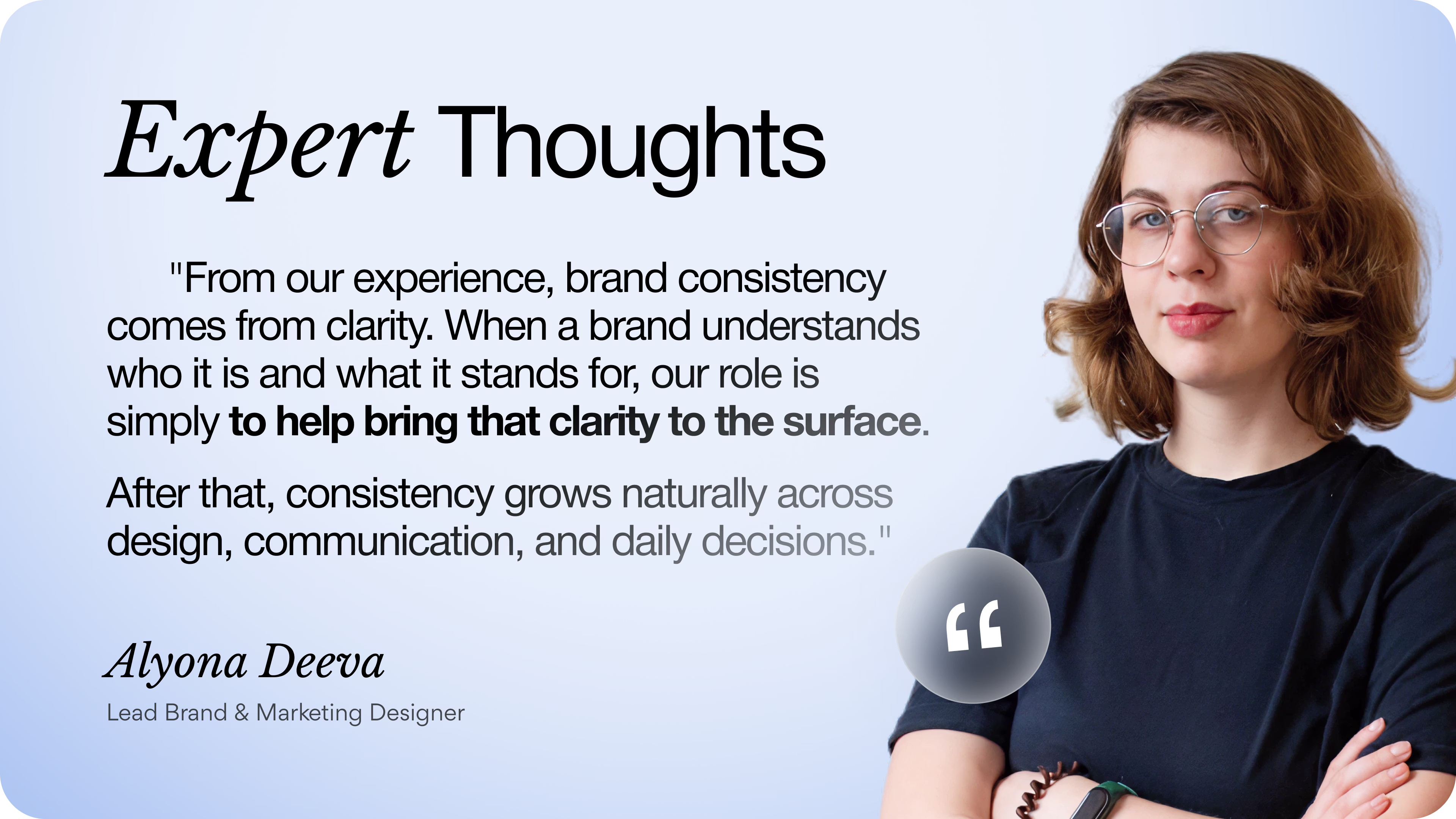
In addition to data analysis, we asked our Lead Branding & Marketing Designer, Alyona Deeva, what she sees as the key factor behind successful product branding:
“Strong branding starts with truly understanding the client and their audience. When you work from real brand needs instead of chasing trends, it becomes easier to experiment and find original solutions. In our experience, the strongest brands grow when you focus on what actually fits them, not on what works for everyone else.”
Strong brands make products easier to choose, trust, and keep using. With 9+ years of experience across SaaS, Web3, AI, Healthcare, and FinTech, our branding services help companies turn positioning into clear product value, higher conversion, and long-term growth.
Wrapping Up
By reflecting on global brand stats and your own product data, you can spot where a brand has lost trust, clarity, or momentum. These signals indicate what’s broken, what needs to be refined or rebuilt. Here, we shared practical insights gleaned from real market data, from our hands-on experience with branding, and from our predictions for 2026.
If you want your product’s brand to drive trust, loyalty, and measurable growth, contact us. Arounda is a design and development agency that helps build strong brand identities that align strategy, product, and real user behavior, so the brand supports growth, beyond just visuals.

Table of contents





FAQ
The real risk is shifting the brand faster than customers can adjust. If the new message doesn’t match how people already perceive your product, sales slow down, and the team spends months repairing trust. Rebranding without clear guardrails usually creates more confusion than clarity.
A company usually feels the need for rebranding when customers hesitate, ask the same questions repeatedly, or misplace the product in a category where it doesn’t belong. Another strong signal is when your offering evolves, but the brand still reflects an older stage of the business. In these cases, the brand becomes a bottleneck, not a support tool.
Strong branding removes hesitation during buying. When value, pricing, and product logic are clear, deals close faster and require less explanation. Customers trust the product sooner, churn less, and spend more over time, which directly increases revenue.
Customers notice when a brand sounds different from one place to another. Even small gaps make them pause and doubt what they’re seeing. When the message stays clear across every step, decisions happen faster.
Most companies see early movement within a few months if the message is focused and repeated often. Deep recognition takes longer because it forms through repeated exposure during real purchase decisions. The more stable and visible the brand, the faster recognition builds.
Awareness means they know the name. Recognition means they can pick you out in an instant and connect you to a promise or a benefit. The second is more important for sales. It affects how customers compare the brands.


89+ Reviews
on Clutch

Top Rated Plus Agency
on Upwork

Top 50 Trending team
on Dribbble

Projects are Featured on Behance platform
