
Enterprise Mobile App Statistics: Adoption, ROI, and Risk Data for 2026


Most enterprise mobile apps get launched with clear goals and real investment behind them, yet far fewer become part of everyday work. Up to 70% of digital initiatives fall short of their adoption targets, and Arounda's work across 300+ digital products and 9+ years confirms that adoption stalls at the same predictable points again and again. Tracking mobile app stats is how enterprise teams spot those drop-off points before they become a bigger problem.
The statistics in this guide exist to help you understand why that happens, where the drop-off points are, and what separates enterprise mobile products that stick from ones that slowly get ignored.
Article Key Takeaways
Inside this piece, the Arounda team covers:
- 30+ key enterprise mobile apps statistics on adoption, engagement, ROI timelines, and failure rates
- Why enterprise mobile adoption numbers look healthy on paper but often mask real usage gaps
- Expert commentaries and practical guidance on reading these statistics in the context of your own enterprise mobile investment.
- How workforce type, industry vertical, and BYOD policy shift the benchmarks you should actually track
- Security and compliance risks that most deployment plans underestimate.
Enterprise Mobile App Adoption Statistics
1. 67% of distributed workforce teams manage business workflows through custom apps:
SOTI's 2025 mobility research shows that custom apps are already embedded in day-to-day operations across distributed workforce environments. At the same time, 58% still rely on manual processes, which points to a clear gap between digital rollout and full workflow adoption.
SOTI, The Mobility Mandate
2. One-third of the U.S. retail workforce still has no dedicated mobile device:
Zebra's latest retail research highlights a major deployment gap in frontline environments. When a significant share of employees still lacks exclusive access to a work device, adoption naturally becomes uneven, especially across larger retail organizations.
Zebra Technologies
3. More than 80% of enterprises permit employee-owned smartphones and tablets:
This points to how widely BYOD has expanded across enterprise environments. As personal devices become part of the work infrastructure, the potential reach of internal mobile apps grows with them, especially in distributed and hybrid settings.
Mordor Intelligence, Enterprise Mobile Application Analysis
4. Workforce MFA adoption reached 70% of users in January 2025:
Okta's data suggests that secure access is now built into a large share of workforce app journeys. While this is not a direct measure of mobile app adoption, it does show how broadly enterprise app access has scaled across employees using protected sign-in flows.
Okta
5. An average uplift of 31% in mobile adoption metrics is typically tied to lower friction and clearer user journeys:
Across mobile product experiences, stronger adoption tends to follow when onboarding is easier, navigation is clearer, and key actions feel more natural to complete. In practice, this kind of uplift usually reflects better alignment between mobile UX and real user behavior.
Arounda Agency
What this Data Means for Enterprise Mobile Adoption:
These enterprise mobile apps statistics show one simple thing. Mobile access is becoming more common among business teams, but real adoption will depend on whether the app makes it easier and faster for people to do their jobs. If employees don't have the right device, clear onboarding, or a useful everyday flow, they won't use it for long. In 2026, businesses need mobile tools that fit in with their daily work and don't make things harder.
Arounda tips for higher mobile app adoption:
- Build the mobile experience around something employees already do every day.
- Let users open the app and complete one core action right away, without long setup or extra steps.
- Test the app in real conditions. Check how it works on the actual devices people use during work, whether that is a shared tablet, a rugged handheld, or a personal phone.
- Remove one friction point from every core flow. This is where many mobile app growth statistics start to make sense in practice, because adoption often improves when repeated actions become easier to complete.
Enterprise App Adoption Funnel: from deployment to active daily use
6. Retention falls to 26% on day 1 and 7% by day 30:
Generally, an app is considered high-performing if it retains over a third of its users after install. Global retention benchmarks reveal that retention falls to 26% on day 1, 13% by day 7, and 10% by day 14. After 30 days, the retention rate generally settles at 7%.
Adjust
7. 46% of frontline workers in the U.S. are mobile-dependent:
46% of frontline workers in the U.S. are now considered mobile-dependent, meaning they cannot complete their core job functions without a mobile device.
IDC
8. Employees now use 8.2 enterprise mobile apps daily:
Employees now use an average of 8.2 enterprise mobile apps daily, a significant increase from the 2021 average of 6.7 apps.
ZipDo
9. App retention drops sharply on both iOS and Android:
On iOS, average app retention was 23.9% at day one, dropping to 3.7% by day 30. On Android, average app retention was 21.1% at day one, dropping to 2.1% by day 30.
Business of Apps
10. Onboarding campaigns can lift opt-in rates by up to 40%:
Apps running onboarding campaigns see increased opt-in rates, as high as 40% above their category average.
Airship

What this data means:
The real bottleneck shows up after the install. People are willing to try a mobile product once, sometimes twice, but regular use forms only when the app removes effort from a repeated task. That is why mobile app download statistics can look healthy while actual adoption stays weak. By 2026 and 2027, enterprise teams will feel this gap more sharply: apps with vague first-session value will keep losing users early, while products tied to a concrete daily action will hold attention longer and earn a place in routine work.
Arounda team's tips for a stronger adoption funnel:
- Build the first session around one repeated job. Do not introduce the whole product. Let a worker check a shift, confirm a delivery, approve a request, or send an update within seconds.
- Audit the first three screens for wasted motion. If setup, permissions, or navigation slow people down before the first useful action, the funnel weakens immediately.
- Track the first completed task. This is where many mobile app download statistics stop being useful, because installs can rise while real workflow adoption stays flat.
- Design for recurrence. Surface the action users come back for most often and make it easier each time. Repetition is what turns a mobile tool into part of the workday.
Workforce Mobile Usage Patterns
11. 60% of the workforce is now made up of frontline employees:
According to Omdia estimates, frontline workers make up 60% of the total workforce. For many of them, the mobile device is becoming the primary compute endpoint for collaboration and access to business data and insights.
Omdia
12. 86% of employees use mobile apps for work:
86% of employees use mobile apps for work, mostly for communication and collaboration.
Clutch
13. More than 80% of enterprises allow employee-owned smartphones and tablets for work:
More than 80% of enterprises now permit employee-owned smartphones and tablets, turning personal devices into primary work terminals and expanding the addressable user base for internal mobile apps.
Mordor Intelligence, Enterprise Mobile Application Analysis
14. 89% of employees check apps after hours, and 66% complete tasks off the clock:
Many employees struggle to disconnect, with 89% checking apps after hours and 66% completing tasks off the clock.
Clutch
15. Only 54% of distributed workers are supported with video, talk, or text tools:
Only 54% of distributed workers are supported with video, talk, or text, highlighting the importance of real-time visibility in managing dispersed teams and their devices.
SOTI, The Mobility Mandate
What this means for enterprise workforce adoption:
These enterprise mobile apps statistics show that mobile is already part of everyday work across frontline, distributed, and hybrid teams. By 2026 and 2027, enterprise teams will need tighter control over device access, communication flows, and mobile support. Stronger mobile app usage statistics will come from systems that are easier to use, easier to support, and easier to manage across real working conditions.
Arounda tips for a stronger workforce mobile adoption:
- Break mobile usage down by role. Identify the tasks each group handles most often on mobile, then simplify those flows first.
- Separate urgent alerts from routine updates. Critical alerts, approvals, and task updates need a clearer structure so mobile work stays focused.
- Add support inside the workflow. Quick access to chat, guidance, or task status inside the flow makes mobile work easier to sustain.
Mobile usage intensity by workforce type and industry
Sources: (16), (17), (18), (19), (20).
What this data means for enterprise mobile strategy by industry:
Mobile usage already follows different patterns across industries. Finance holds longer sessions, logistics relies on frequent device use, healthcare links mobile to speed, and crypto is still gaining session momentum. For enterprise teams, this means one thing: mobile products will be judged more heavily by how well they fit the pace of work inside each vertical. In that context, mobile conversion rates will depend more on usage fit than on broad market averages.
Arounda tips for stronger mobile usage by industry:
- Define the main mobile task for each vertical. Focus the product around the action people repeat most often in that environment.
- Measure real usage rhythm. Look at session length, task frequency, and repeat actions to understand how the product fits daily work.
- Shape the UX around working conditions. Mobile flows should reflect where and how people use them, whether that happens at a desk, on the move, or under time pressure.
Enterprise Mobile App ROI Statistics
21. Workspace ONE UEM delivered 170% ROI over three years:
Workspace ONE UEM delivered $51.1 million in benefits over three years versus $18.9 million in costs, resulting in $32.2 million in net present value and 170% ROI.
Omnissa / Forrester TEI
22. Three or more digital adoption best practices can drive 85% ROI:
Organizations that embrace three or more digital adoption best practices achieve an 85% ROI on digital transformation projects.
WalkMe
23. Power Apps delivered 206% ROI and $31.0 million NPV:
The composite organization experiences $46.1 million in benefits over three years versus $15.1 million in costs, adding up to $31.0 million in net present value and 206% ROI.
Forrester TEI / Microsoft
24. Power Apps reduced internal workflow app development time by 50%:
With Power Apps, the composite organization's professional developers are able to reduce the amount of time they spend building apps for internal workflows, resulting in a 50% reduction in app development time.
Forrester TEI / Microsoft

What This Means for Enterprise Mobile ROI:
Mobile app revenue statistics show a clear shift: ROI is becoming more operational and easier to track. The market is placing more value on workflow speed, lower delivery costs, and faster app execution inside real business processes. Mobile apps statistics confirm that in 2026 and 2027, mobile products will be judged more often by measurable gains in time, cost, and delivery performance.
Arounda tips on turning mobile investment into measurable returns:
- Start with one workflow that already carries a cost. Approvals, service updates, reporting, and internal requests are easier to measure and improve.
- Measure time saved in execution, not only app usage. Faster completion, fewer manual steps, and lower support effort show value more clearly.
- Reduce build and maintenance load early. Mobile ROI grows faster when teams spend less time shipping, fixing, and updating internal tools.
ROI timeline benchmarks by enterprise mobile app category
Sources: (25), (26), (27), (28).
What this means for enterprise teams:
Payback speed depends on deployment complexity, not ambition. Field service, collaboration, and workflow automation apps return investment in under six months because they replace specific, repeatable tasks. ERP systems take nearly three times longer because integration and rollout complexity delay measurable gains. Tracking mobile conversion rates inside individual workflows gives enterprise teams the clearest early signal that an investment is working.
Arounda tips on building mobile products that reach payback faster:
- Start with workflows that already have a known cost. Approvals, scheduling, and service updates show returns from day one.
- Design for task completion over feature depth. Fewer steps in one workflow outperform broader tools in early ROI cycles.
- Build reporting into the product at launch. Teams that show time saved in the first 90 days make a stronger case for continued investment.
Security and Compliance Risk Statistics
29. 85% of organizations report increasing mobile attacks:
The Verizon 2025 Mobile Security Index shows that mobile devices are under attack more than ever, with 85% of organizations reporting increasing mobile attacks.
Verizon
30. 75% of organizations increased mobile security spending over the last year:
Organizations are continuing to close security gaps, with 75% increasing mobile security spending over the last year.
Verizon
31. 55.1% of mobile devices used at work are running a vulnerable operating system:
55.1% of mobile devices used at work are running a vulnerable operating system, pointing to a major exposure gap across enterprise mobile environments.
Jamf
32. Fortune 500 companies are adopting the highest-assurance factors at the fastest pace:
Fortune 500 companies are adopting the highest-assurance factors at the fastest pace, with 69% YoY growth of Okta Verify FastPass.
Okta
What this means for security teams:
Today, mobile is the main attack surface for most enterprises. The market knows it's an issue, but since 55% of work devices are running vulnerable operating systems, the gap between knowledge and action is huge. Applying mobile UX best practices to security flows directly reduces this gap.
Arounda tips on closing the security execution gap:
- Design authentication flows with one tap as the target.
- Add a single OS status screen to employee-facing apps.
- Surface permission and access controls are needed at the moment, not during onboarding.
Enterprise Mobile App Failure Statistics
33. Mobile workers spend over seven hours per week on admin tasks:
Mobile workers report spending over seven hours per week on admin duties like filling out forms or hunting for information.
Salesforce
34. Mobile app usage could decline by 25% by 2027:
Gartner forecasts that mobile app usage will decline by 25% by 2027 due to increased use of AI-powered assistants.
Gartner
35. Most apps lose over 95% of users after 30 days:
The churn rate for most apps sits at over 95% after 30 days, and out of the 5% that stay, less than 5% will subscribe.
Business of Apps
What this means for enterprise app strategy:
Enterprise mobile apps statistics show a clear pattern: apps get deployed but don't get used. Manual work stays manual, engagement drops fast, and AI assistants are starting to replace direct app interaction. The products that hold adoption by 2027 will be the ones built around actual daily tasks. For enterprise buyers, mobile app industry statistics like these move the question from "did we launch" to "do people use it."
Arounda tips on building apps that hold engagement:
- Design around the task that costs the most time. Forms, approvals, and information lookup are solvable when the app follows the workflow, not the system.
- The first two weeks after launch are the highest-risk period. Early disengagement comes from friction.
- Build for AI-readiness now. Apps that complete tasks without requiring navigation will hold engagement as assistants become the default interface.
If your mobile app is losing users to friction, slow flows, or unclear navigation, a mobile app design partner can help fix that before it becomes a retention problem.
Arounda's work with Reforge shows how structured design solves exactly this. Reforge is a gamified fitness app built around manga-inspired progression mechanics. The challenge was translating abstract game logic, including XP, ranks, badges, and attributes, into workout flows that felt natural and easy to follow. The product logic kept evolving throughout the project, which made UX consistency harder to maintain at every stage.
Arounda structured the entire experience around a single cause-and-effect chain: onboarding quiz, workout, measurement input, XP, rank. Every screen supported that flow. The same principle applies to enterprise tools where complex system logic needs to become a clear, low-friction experience for the end user.
.avif)
The result was a 74% task completion rate in usability testing, a 41% reduction in cognitive load score, and 3x faster program creation for coaches.
Top reasons enterprise mobile apps fail to reach adoption targets
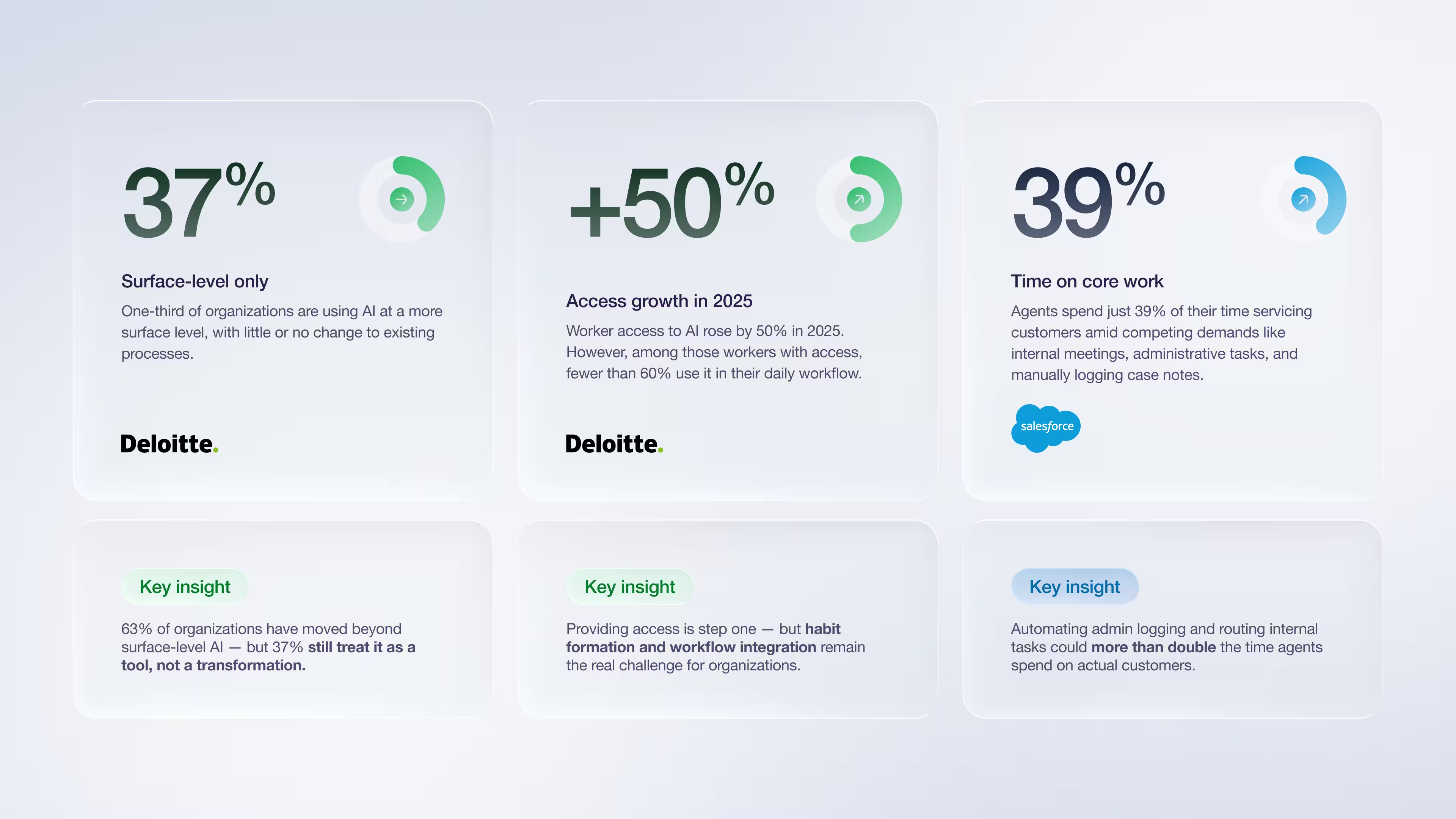
36. 37% of organizations still use AI at a surface level:
One-third of organizations are using AI at a more surface level, with little or no change to existing processes.
Deloitte, The State of AI in the Enterprise
37. Access is rising faster than daily workflow use:
Worker access to AI rose by 50% in 2025. However, among those workers with access, fewer than 60% use it in their daily workflow.
Deloitte, The State of AI in the Enterprise
38. Agents spend only 39% of their time on core service work:
Agents spend just 39% of their time servicing customers amid competing demands like internal meetings, administrative tasks, and manually logging case notes.
Salesforce
39. 21% cite employee readiness as a barrier to adoption:
21% of AI decision-makers cite employee experience and readiness as a barrier to AI adoption. Poor AI literacy continues to erode trust in AI and leads to poor adoption.
Forrester
Based on the data above, most enterprise mobile apps fail for the same reasons:
- Deploying tools without redesigning the workflows around them
- Expanding access faster than employee readiness
- Building for stakeholder requirements instead of actual user tasks
- Treating adoption as a launch milestone rather than an ongoing process.
Arounda expert insight:
"One of the main reasons enterprise mobile apps fail is that teams try to replicate the full desktop system on a small screen. Mobile should be designed as a companion to the desktop, not a copy of it. Its role is to help users stay informed and take quick actions, such as checking updates or approving requests. When mobile focuses on supporting these lightweight interactions, adoption tends to improve significantly."
Margaryta, UX/UI Designer at Arounda
Industry-Specific Enterprise Mobile Benchmarks
40. FinTech:
Global finance app session lengths increased 8% in 2025, reaching an average of 7.18 minutes.
Adjust, Mobile app trends
41. Web3/Blockchain:
McKinsey assigned blockchain a low enterprise adoption score of 1.5 out of 5 in 2025, pointing to early-stage momentum across industries such as finance and manufacturing.
McKinsey
42. SaaS:
The mobile CRM market is projected to grow from $28.43 billion in 2024 to $58.07 billion by 2034, at a CAGR of 11.9%.
Fortune Business Insights
43. AI:
Regular use of AI tools among frontline employees stalled at 51% in 2025, compared to more than 75% for leaders.
BCG
44. Healthcare:
In a UCSF Healthcare mobility workflow, removing device reset tasks from clinical staff reduced device turnover time from 30–40 minutes to 3–5 minutes.
Jamf
What these mobile app industry statistics show:
- FinTech: Longer finance app sessions suggest that mobile is becoming a steady channel for high-value tasks, approvals, and account activity.
- Web3/Blockchain: Low enterprise adoption shows that the category is still developing and that practical use cases matter most.
- SaaS: Growth in mobile CRM reflects stronger demand for business tools that support work across devices and throughout the day.
- AI: AI access is expanding, but regular use among frontline teams is still uneven, which points to a workflow gap.
- Healthcare: Faster device turnover highlights how strongly mobile process design affects clinical speed and staff efficiency.
Arounda’s suggestions by the industry:
- FinTech: Focus on speed, clarity, and fast approvals in high-frequency mobile flows.
- Web3/Blockchain: Build around one simple mobile use case first, such as tracking, verification, or approval.
- SaaS: Put updates, comments, approvals, and reminders at the top of your to-do list.
- AI/ML: Use AI to simplify actions, not to add complexity. Summaries, autofill, and next-step guidance work best.
- Healthcare: Design for real-life clinical situations: shared devices, quick handoffs, and a few taps.
Your product may need to meet a lot of specific industry requirements, but strong mobile performance tends to rest on the same foundations: smart design decisions and mobile UX best practices that underpin trust, clarity, and reuse. A great example is our work with Lyynk, a French health-tech app for young people's mental wellbeing.
Lyynk needed a safer and more intuitive mobile experience for both teens and trusted adults. Our team redesigned the app with clearer flows, better navigation, quick access to key tools, and a calmer visual system that made emotional tracking and communication easier to use.
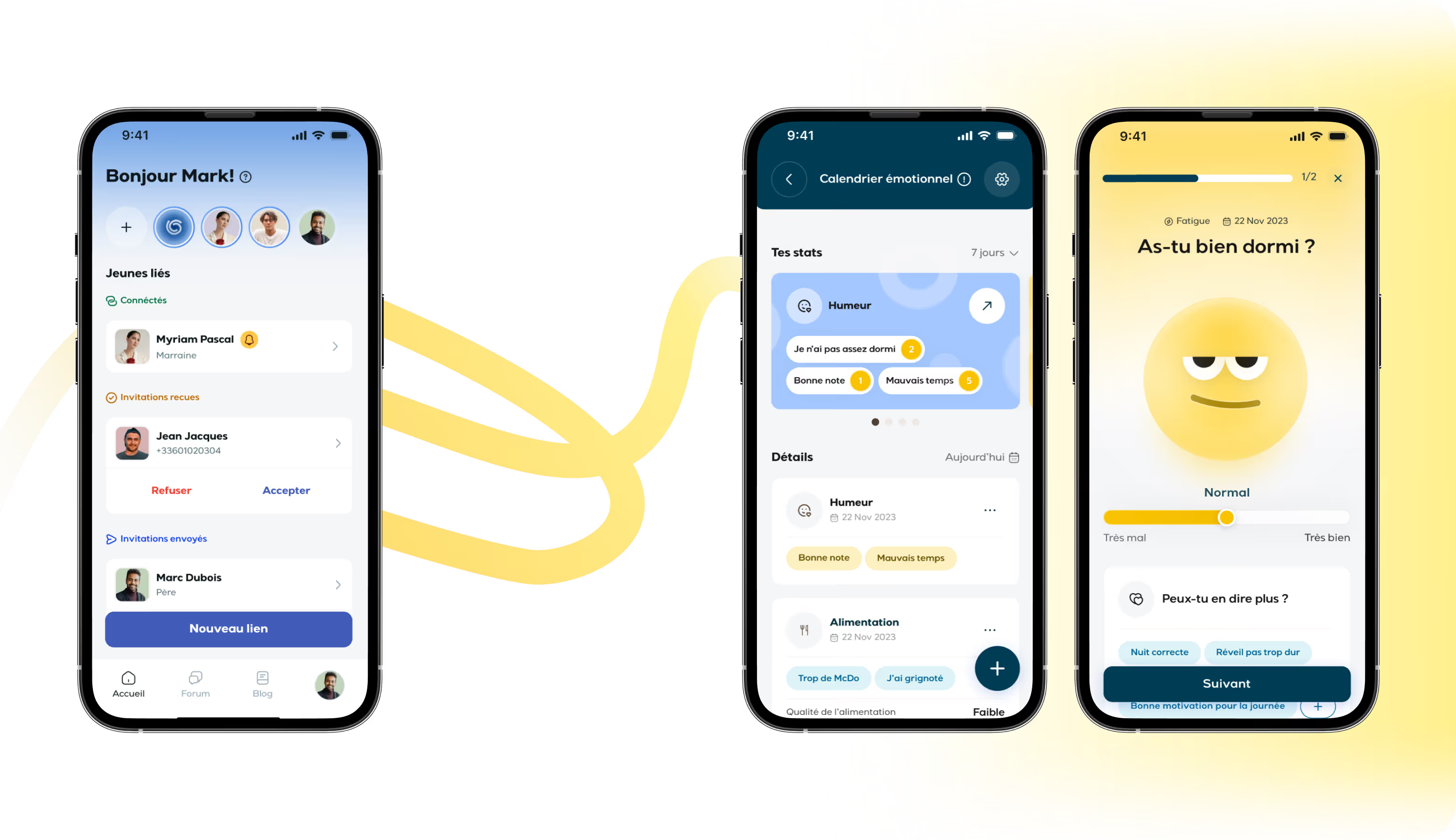
This led to +38% user engagement growth, +42% retention increase, a 4.9★ rating, and thousands of downloads.
Key mobile metrics by enterprise industry vertical
Not every mobile metric carries the same weight across industries. Each vertical has its own pressure points, workflows, and user expectations, which means enterprise teams need to focus on the signals that matter most in their specific product environment.
Mobile App Development Trends Shaping Enterprise in 2026
45. Custom apps remain a priority for complex workflows:
Custom apps still play a major role in enterprise environments with specialized operations, as 59% of companies hire development firms to build apps tailored to their needs.
Clutch
46. BYOD keeps expanding across enterprise environments:
The BYOD and enterprise mobility market was valued at USD 84.80 billion in 2024 and is projected to reach USD 188.30 billion by 2032, growing at a 9.2% CAGR as companies continue to support more flexible mobile work models.
Data Bridge Market Research
47. AI agents are moving into enterprise strategy:
According to Microsoft's Work Trend Index, 81% of leaders expect agents to be moderately or extensively integrated into their AI strategy within the next 12–18 months, while 46% say their companies already use agents to fully automate workflows or processes.
Work Trend Index
48. Task-specific AI agents are entering enterprise apps fast:
Gartner predicts that 40% of enterprise applications will be integrated with task-specific AI agents by the end of 2026, up from less than 5% today, showing how quickly enterprise software is shifting toward more embedded AI support.
Gartner
49. Cloud-based enterprise mobile apps continue to lead:
Cloud-based enterprise mobile apps held a 67.92% revenue share in 2025 and are growing at a 14.12% annual rate, reflecting stronger enterprise demand for scalable, remote-ready mobile systems.
Mordor Intelligence, Enterprise Mobile Application Analysis
What these trends suggest for enterprise teams:
Enterprise mobile is moving toward more tailored products, broader device access, and deeper AI support inside daily workflows. Looking at these trends in mobile apps, the next phase will likely bring fewer broad all-in-one tools and more focused mobile systems built around specific tasks, flexible environments, and faster execution.
Arounda tips for keeping up with enterprise mobile trends:
- Focus on the task users return to most often and make it easy to complete on mobile.
- Support shared devices, personal devices, remote teams, and cloud-based access from the start.
- Use AI in practical moments. Add it where it saves time, reduces effort, or helps users move through tasks more smoothly.
- As the product grows, navigation, priorities, and key actions should stay clear.
Keeping up with enterprise mobile trends also means turning them into product decisions that improve trust, clarity, and conversion in real use.
Our work with PayPossible, a fintech platform for banks, lenders, and merchants, is a good example. The product needed a website and mobile experience that were easier to understand and could explain a complicated multi-lender model, build trust faster, and make important actions easier to do.
We redesigned the website and mobile experience using research-based UX, easier navigation, step-by-step registration, responsive layouts, and custom visuals that made the financing logic easier to understand.
This method was in line with the trends seen in enterprise app statistics: users are more likely to respond when flows are clearer, trust builds faster, and important actions are easier.

This led to 2× merchant signups, +40% completed financing applications, 88% user satisfaction, and UI award recognition.
What These Numbers Mean for Enterprise Mobile Strategy
Looking across these enterprise mobile apps statistics, the market is moving toward more embedded, workflow-driven mobile products shaped by AI, cloud systems, and broader device access. At the same time, mobile UX best practices are becoming more important because rollout alone does not guarantee adoption. Products perform better when they reduce friction, support real tasks, and help users move through key actions with speed and clarity.
When building a mobile app for an enterprise, focus on a few things first:
- Design around one core workflow.
- Reduce friction in high-value moments.
- Support real working conditions.
- Measure behavior, not just rollout.
The mobile app design trends shaping the market point to more focused, adaptive, and workflow-driven products. Teams that respond early will have a stronger chance to improve adoption, retention, speed, and operational value. A strong design and development partner can help turn that into a product strategy.
Summary
Enterprise mobile products hold attention when they make everyday work easier, faster, and clearer for the people using them. The statistics gathered here help show where the market is heading and, more importantly, how enterprise teams can read those signals to make better product decisions now. That includes reducing friction, supporting repeat tasks, and improving the parts of the experience that shape trust, retention, and daily use.
Our Arounda team has experience creating enterprise products and improving existing ones when they no longer support business goals, user needs, or product growth. If you need to design, refine, or rethink an enterprise mobile app, contact us.



Table of contents






FAQ
Based on current mobile app statistics, a practical enterprise benchmark is about 60%, especially in companies with frontline, field, or operations-heavy teams. From our experience, that share goes up when mobile apps are tied to real daily tasks like approvals, reporting, scheduling, or internal communication.
Enterprise mobile apps typically have a smaller rollout base, but stronger repeat usage once they become part of daily work. Consumer benchmarks are much weaker on long-term retention: average Day 30 retention is just 2.1% on Android and 3.7% on iOS. This is why enterprise teams need to measure success by active workflow usage and not installs alone.
A strong benchmark is under 6 months to first payback for well-scoped enterprise mobile products tied to clear operational use cases. From our experience, that usually happens when the app is built around measurable improvements in productivity, workflow speed, service delivery, or error reduction.
The two strongest categories are usually healthcare and fintech. Healthcare stays high because mobile access is now deeply tied to care delivery, records, messaging, and patient-facing services, while fintech leads on frequent, high-intent user actions and strong session growth. This matches broader trends in mobile apps we see across enterprise products.
BYOD usually increases access, but it also raises risk. A concrete number here is that 70% of mobile devices impacted by an attack are personal rather than corporate-issued, which is why BYOD can lift usage but also create more security pressure around compliance, control, and support. From our perspective, BYOD helps adoption only when governance is strong enough to support it.
The two most common reasons are poor integration and inadequate onboarding or usability. Integration is a critical blocker because organizations are now managing hundreds of apps, but often only a few of the enterprise applications are integrated, making mobile experiences feel fragmented from day one. In general, this is one of the most obvious trends in mobile apps today: they fail when they are launched as standalone tools rather than as part of a real workflow.


89+ Reviews
on Clutch

Top Rated Plus Agency
on Upwork

Top 50 Trending team
on Dribbble

Projects are Featured on Behance platform
