
Brand SWOT Analysis for Companies That Cannot Afford Blind Spots


A brand usually starts losing ground when the experience stops supporting the promise behind it. Once that happens, 52% of customers stop buying after a product or service fails expectations. For enterprise companies, that risk spreads fast across markets and touchpoints, which makes regular brand analysis a strategic necessity. Our Arounda team prepared this guide to show how brand SWOT helps uncover risk before it turns into a larger brand and business problem.
Article Key Takeaways
Our Arounda Team prepared this list to cover the core decisions behind enterprise brand work:
- How brand SWOT analysis helps large companies spot risk, pressure points, and hidden gaps earlier
- Industry insights, practical advice, and real-life examples that make the brand SWOT more useful in complex organizations
- Expert thoughts of Vlad Gavriluk, CEO & Founder, on strategic brand decisions and risk signals, and Tetiana Yavorska, Brand & Marketing Designer, on design signals and brand–product misalignment
- What can distort the process, from internal politics to conflicting market realities
- When teams should update their SWOT and how to present it to leadership clearly.
The Politics That Corrupt Enterprise Brand SWOT Before It Starts
Political pressure often shapes the outcome long before an enterprise brand discussion becomes formal. A serious brand analysis can lose value when teams protect internal narratives, avoid friction, or soften what the market is already signaling. A strong SWOT analysis of a brand depends as much on decision culture as it does on brand data.
“Most brand SWOTs look clean by the time they reach leadership. Teams smooth out sharp points, rephrase risks, and leave out things that may raise questions. You end up with a document that feels aligned, but does not reflect the real situation. Ask for the unfiltered version before any approvals. If there is no tension in it, the key issues are still hidden.”
Vlad Gavriluk, CEO & Founder of Arounda
Weaknesses get softened until they stop being useful
Many teams describe weaknesses in language that feels acceptable internally but says very little in practice. A weak brand SWOT analysis starts sounding polished when it should sound precise, which makes it harder for leadership to see where trust, clarity, or relevance already started slipping.
Common signs include:
- Weaknesses that sound vague enough to avoid tension
- Issues framed as temporary friction instead of structural brand gaps
- Internal preferences are treated as market truth.
Arounda's fix:
Rewrite every weakness in terms of business impact. If the point does not explain what it affects, where it shows up, and why it matters now, it still is not ready for the SWOT.
Threats get listed but never owned by anyone
A threat in a slide deck does not reduce risk by itself. In many companies, brand analysis identifies the issue, but no team takes responsibility for tracking it, which turns the SWOT analysis for brand work into passive documentation instead of a management tool.
This usually happens when:
- Teams treat threats as background context
- No owner tracks movement or escalation signals
- Leadership reviews the list without assigning action.
Arounda's fix:
Attach an owner, a review point, and an escalation trigger to every material threat. That turns the SWOT from observation into a working management tool.
A strong example of how a category threat can become a focused brand task comes from Loca Travel. When they came to our Arounda Team, the risk was already visible: the platform was entering a category crowded with lookalike travel brands, which reduced memorability and made it harder to build a distinct presence across channels.
We turned that threat into a concrete brand task through brand identity, logo design, brand guidelines, marketing design, a UI framework, social templates, and OOH materials, so the team could manage recognition and consistency with far more control.

That work resulted in a 60% increase in brand recall, 3x faster marketing asset production, a 29% increase in session depth, and a full delivery cycle completed in 4 weeks.
When One Brand Operates Across Contradictory Markets
A brand that works in one market may lose relevance in another. Since 34% of consumers would switch to a brand that feels more personal, brand SWOT analysis should test strengths and risks against local expectations.
A strength in one region that is a liability in another
A brand trait that supports growth in one region can create distance in another. A SWOT analysis of a brand should test every stated strength against local buying logic, trust cues, and cultural expectations, because the same tone, pace, or visual language can signal very different things depending on the market.
This usually becomes visible when:
- A premium tone builds authority in one region and feels cold in another
- A playful identity improves recall in one market and weakens trust in another
- A fast commercial message helps conversion locally and feels aggressive elsewhere.
Arounda's fix:
Recheck every major strength market by market. If one trait drives opposite reactions, keep the core brand idea and adapt how the brand expresses it in each region.
How global brand consistency becomes a strategic weakness
Global consistency can start hurting the brand when teams protect sameness after the market has stopped reading it as clarity. Strong brand analysis should separate what must stay fixed from what should flex across regions, channels, and buyer contexts, especially when different audiences need different proof before they trust the same promise.
Common signs include:
- Teams standardize tone where local relevance matters more
- Central guidelines leave no room for regional proof points
- Visual consistency hides important differences in audience expectations.
Arounda's fix:
Define a fixed core and a flexible layer. Keep the promise, recognition cues, and positioning logic stable, then adapt messaging, examples, and experience details to each market. When the gap runs deeper, selective rebranding can help realign the brand with regional expectations.
Brand SWOT as a Crisis Prevention Tool, Not a Planning Slide
A strong brand SWOT analysis helps teams respond while the issue is within reach. Once the same weakness starts surfacing through trust signals, buyer hesitation, regional workarounds, or message drift, the problem has already reached execution and begun shaping perception in the market. That is often the moment when redesign becomes necessary, because it helps bring the lived brand experience back into line with what the company claims to stand for.
What Triggers a Brand SWOT Update Outside of Planning Cycles
Brand perception often changes before teams notice it. After ownership shifts, leadership updates, or external pressure, the market starts reacting to a different version of the company while internal assumptions stay the same. At that point, brand analysis should reflect what customers already see and experience, and a SWOT analysis for a brand needs to capture the current state the business operates in.
M&A that reshapes brand perception overnight
M&A (mergers and acquisitions) combines companies, products, and teams into a single structure. From the market's point of view, the brand changes instantly. Customers see a new offering, new messaging, or a different scope, even if the company itself still operates on old assumptions. A brand SWOT analysis at this stage exposes where the new reality and the old brand logic no longer match.
This shift happens through visible changes:
- Product portfolio expands or overlaps, but positioning stays fragmented
- New capabilities appear, but messaging still reflects the previous scope
- Different brands or sub-brands coexist without a clear hierarchy
- Website structure combines products without explaining how they connect
- Sales and marketing teams communicate different values depending on origin.
A common scenario: one company sells a simple SaaS tool, another brings enterprise features after acquisition. The combined product targets larger clients, but the website, pricing, and messaging still speak to smaller teams. This creates confusion and weakens trust.
Arounda's fix:
- Start with alignment across product, marketing, and sales. Map all value propositions, audiences, and use cases to spot overlaps and conflicts, then define one primary value proposition for the combined business.
- Next, rebuild the structure. Update website navigation and key pages so they reflect the new product logic, not legacy entities. Align messaging across touchpoints so the same story holds from marketing to sales.
- Finally, validate in practice. Check how teams present the product and review real conversations with customers. If the message shifts between teams, alignment still needs work.
Leadership change and what it does to brand trust signals
A leadership change resets priorities faster than a brand signal update. Teams start acting on a new direction, but the market still sees the old one. This gap shows up in communication, product focus, and customer experience. A brand analysis helps identify where trust starts weakening and where signals no longer match actual decisions.
Where this becomes visible:
- Website messaging reflects the previous strategy
- Product positioning shifts, but key pages stay unchanged
- Leadership communicates new priorities that marketing does not support
- Sales adapts messaging faster than the brand and creates inconsistent promises
- New initiatives appear without connection to the existing brand structure
- Tone of voice varies between channels and touchpoints.
A SWOT analysis of a brand helps identify which trust signals no longer support the new direction and where the brand starts losing consistency.
Arounda's fix:
Clarify the new strategic direction early and translate it into visible changes across key touchpoints. Update positioning, messaging, and key pages, then reflect the same logic in UI/UX design through structure, flows, and content hierarchy. Align sales and product communication, and review how teams present the product in real conversations to catch gaps early.
Regulatory decisions that turn a strength into a liability
Regulation can change how a brand is perceived without any change in the product itself. What once worked as a competitive advantage can start raising questions once new rules redefine what is acceptable, transparent, or compliant. A brand SWOT analysis helps identify where existing strengths begin to create risk under new conditions.
What starts breaking under regulation:
- ''Instant approval'' turns into extra verification steps, but the promise of speed stays unchanged
- Pricing looks simple on the website, yet additional fees appear later in the process
- ''No paperwork'' messaging conflicts with required document uploads during onboarding
- Automation is highlighted, but users still need to manually confirm key actions
- Disclaimers appear as separate blocks and break the logic of the main message.
A common case appears in fintech or health products. A brand highlights simplicity and fast onboarding, but new regulations require more steps, verification, and explanation. The original promise stays visible, but the experience no longer supports it.
Arounda's fix:
Review homepage, product pages, and onboarding screens and remove claims that no longer match the real flow. Rewrite value propositions with actual steps and conditions. Update website design so verification and requirements are visible upfront. Test the full journey and fix any mismatch between promise and experience.
"You start questioning a brand when the experience does not match what it promises. People may not always explain it, but they feel that something is off. A useful check is to step outside the design perspective and watch how real users react. They quickly point out what feels confusing or inconsistent, and that is usually where the gap becomes visible."
Tetiana Yavorska, Brand & Marketing Designer
How to Present Brand SWOT to C-Suite Without Losing the Hard Truths
Companies that align their brand promise with the experience they deliver can reach up to 3.5× higher revenue growth. This sets a clear expectation for how closely brand signals need to match actual product and customer experience.
At this level, a SWOT enters a different context. Leadership does not evaluate the brand in isolation; it connects it to growth, market position, and risk. A strong brand analysis needs to show where current perception already affects decisions, not just how the brand looks on paper.
A SWOT analysis for a brand should focus on what changes outcomes. It needs to reflect current conditions, highlight pressure points, and make it clear where action is required now.
If you want your SWOT to influence decisions, structure it this way:
- Define a small set of issues that already impact revenue, conversion, or deal quality. Avoid broad categories and focus on situations the business recognizes.
- Turn each point into a concrete scenario. Show where it appears, who is affected, and how it influences outcomes in real terms.
- Support every claim with current signals. Use customer behavior, feedback, or performance data that leadership can relate to.
- Assign ownership before the discussion. Each issue should connect to a team that can act on it immediately.
- Prepare a clear next step. Leadership should see what needs to change and what will happen next without additional interpretation.
Brand SWOT Examples Worth Studying – and Why They Worked
A strong brand SWOT analysis proves its value through the changes it drives in real decisions. The examples below focus on situations where brand structure, perception, and product reality drifted apart, and how aligning them influenced adoption, clarity, and growth.
HRWorkCycles – aligning product structure with brand system
HRWorkCycles operated three HR products with separate websites and inconsistent design. The platform worked as a system, but the brand did not reflect that, which weakened recognition and made evaluation harder.
The challenge came from the structure. Each product communicated its own value, but the connection between them stayed unclear.
Here is what we did and what it changed.
We built a unified brand and design system that connects all products through shared visual rules and a clear hierarchy. Each product kept its role, but became part of a structured ecosystem. The same logic carried into UI, onboarding flows, and dashboards, so the experience matched the brand.

What this led to:
- +28% conversion from demo to active usage
- +91% user satisfaction
- +35% brand recognition across the product suite
FlowFunds – rebuilding trust through consistency across touchpoints
FlowFunds combined banking, finance, and investment tools into one platform. The product was complex, but the brand did not communicate reliability, which affected trust.
The challenge appeared across touchpoints. Web, mobile, and marketing followed different logic, which created friction during onboarding and key actions.
Here is what we did and what it changed.
This brand SWOT analysis example shows how structural alignment affects trust at scale. We rebuilt the product ecosystem so all platforms follow the same navigation logic and visual hierarchy. Core actions like transfers, top-ups, and card management moved to the main screen, which reduced friction in everyday use. We also introduced modular dashboards that break complex financial data into clear sections, so users can quickly understand their state and go deeper when needed.

What this led to:
- x2 user growth within six months
- 150k+ new users monthly
- +40% session time
- 90% user satisfaction
Signals Your Brand SWOT Is Already Outdated Before You Present It
A SWOT can become outdated faster than teams expect. The brand keeps evolving through new features, markets, and decisions, but the document often stays tied to an earlier stage. A brand analysis helps surface these shifts, especially when the website says one thing and the product shows another.
A SWOT analysis for brand needs to reflect what the business looks like right now. Once it falls behind, teams rely on a version of the brand that no longer matches how the company operates.
Common signals to watch:
- Teams describe the brand differently across marketing, product, and sales
- Website messaging no longer matches how the product works in reality
- New features or markets appear, but positioning stays the same
- Conversion or trust drops without a clear internal explanation.
If you notice these patterns, the issue usually goes beyond communication. Misalignment starts affecting perception, decisions, and growth. This is the point where rebranding or a focused UX audit helps identify weak spots and turn them into a clear plan.
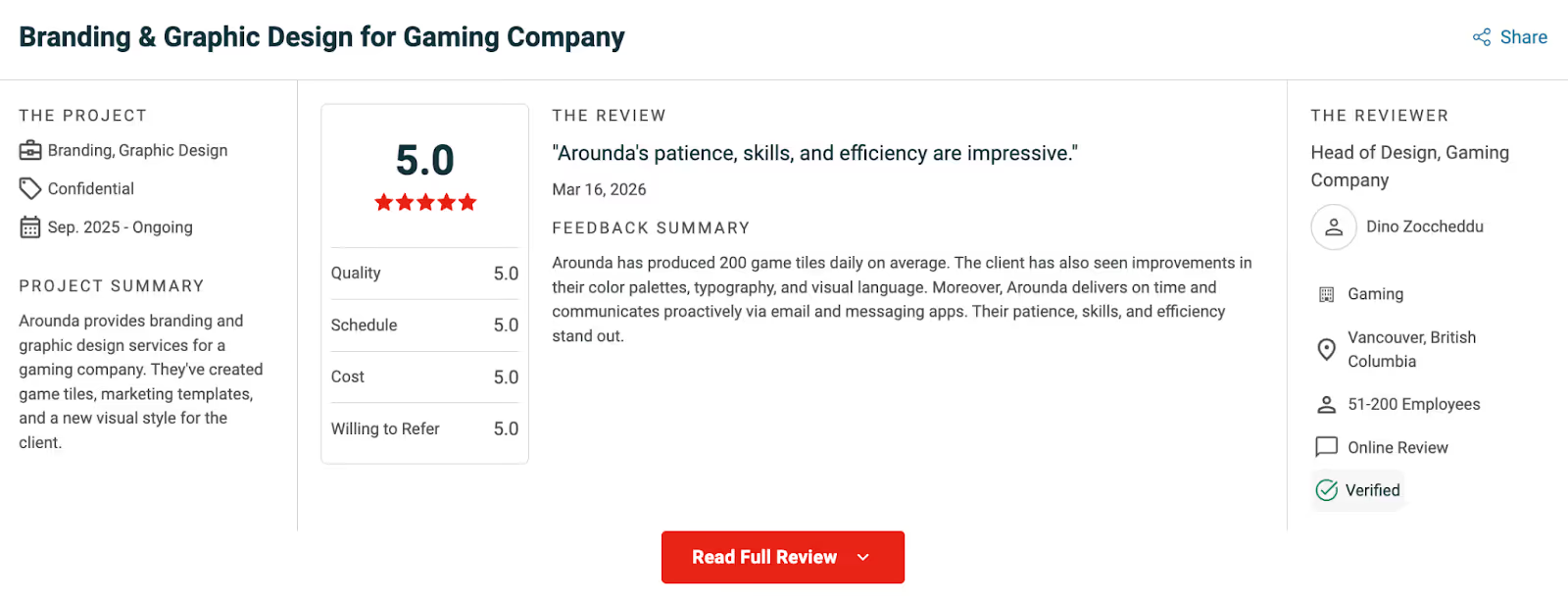
Arounda brings 10+ years of experience and 350+ completed projects across complex products and markets. With a 5.0 rating on Clutch, we help teams identify weak signals early and translate them into structured brand and product improvements.
Summary
Brand gaps rarely start as visible problems. Over time, they affect trust, conversion, and growth as signals drift across product, marketing, and sales. A structured brand SWOT helps surface misalignment, highlight real risks, and support clearer decisions across teams and markets.
Inconsistent messaging, unclear positioning, or drops in trust and conversion usually point to deeper issues. Strong branding, clear structure, and aligned product experience can improve performance and scalability. To address these gaps and build a brand that supports growth, contact us.



Table of contents







FAQ
A large organization should review its brand SWOT analysis every six months. Teams should also update it after acquisitions, leadership changes, market expansion, regulatory pressure, or a visible reputation issue. Fast-moving sectors often need a quarterly review.
The brand strategy lead or corporate marketing lead should run the SWOT analysis for brand process. Product marketing, communications, regional teams, sales, customer insights, and legal or risk leaders should contribute their input. An executive sponsor should confirm the final version and approve the next steps.
A brand SWOT analysis highlights the internal and external factors that shape strategic decisions right now. A brand audit examines brand perception, positioning, messaging, visual identity, channel performance, and market context in more detail. Teams often use audit findings to sharpen the SWOT.
A team should use its brand SWOT analysis to decide when a threat calls for action. Leaders should move immediately when a threat can damage trust, revenue, compliance, partner confidence, or public perception in the near term. Teams can monitor a threat when signals remain weak, impact stays unclear, and the company still has time to assess exposure. Every threat needs an owner, a review date, and a clear escalation trigger.
During rapid growth, a SWOT analysis of a brand can lose accuracy surprisingly fast, since the brand context changes along with the business itself. Expansion brings new audiences, new expectations, and new points of pressure that often did not exist when the analysis first took shape. Without regular revision, the SWOT starts pointing leaders toward decisions based on an outdated understanding of the brand.


89+ Reviews
on Clutch

Top Rated Plus Agency
on Upwork

Top 50 Trending team
on Dribbble

Projects are Featured on Behance platform
